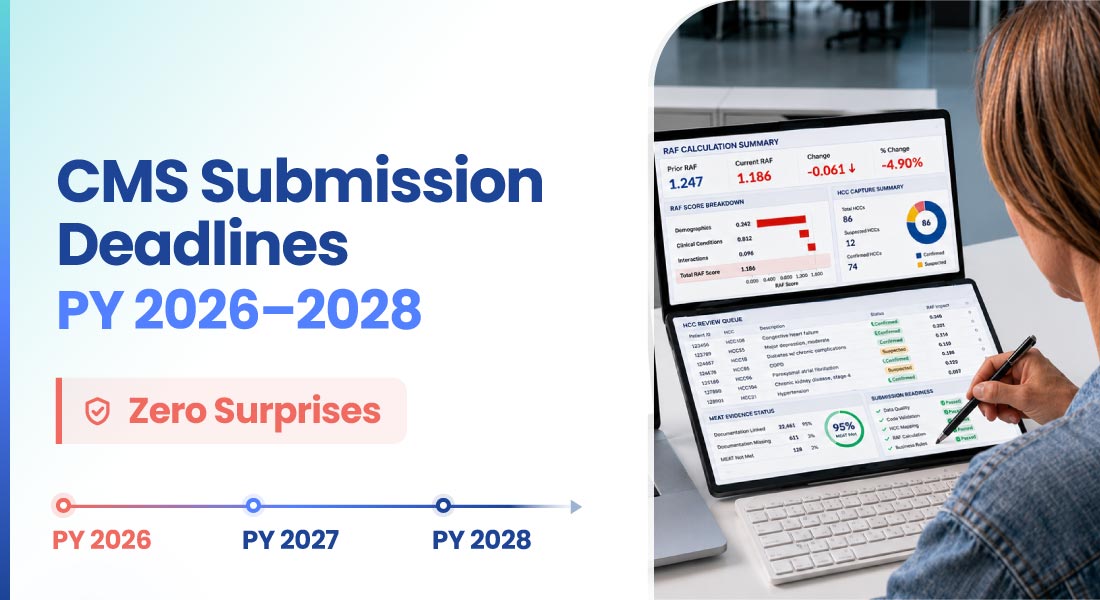
Quick Answer: When Is Risk Adjustment Data Due?
Risk adjustment data must be submitted by 8 PM ET on each date in the annual CMS HPMS memo. The initial deadline is the first Friday in September before the payment year. The mid-year deadline is the first Friday in March. The final deadline closes about 13 months after the payment year ends. One rule drives the rest: after the final deadline, CMS only processes deletes. Adds submitted late earn nothing. Late deletes still count against payments.
Key Takeaways
- Risk adjustment data must be submitted by 8 PM ET on each CMS HPMS memo date.
- Initial deadlines land the first Friday in September; mid year, the first Friday in March.
- Late submissions are dropped from risk score calculation runs and never carry into later payment years.
- After the final deadline, deletes still process, so cleanup protects payments when adds no longer can.
2026-2028 CMS Data Submission Deadlines at a Glance
Three payment years are in motion at once. Medicare Advantage organizations should track these payment years closely [1]:
Payment year | Run | Deadline | Payments settled |
PY 2027 | Initial | September 4, 2026 | Payments for the start of the payment year |
PY 2026 | Final run | February 1, 2027 | Final payments for PY 2026 |
PY 2027 | Mid year | March 5, 2027 | Interim risk score and payments refresh |
Two more risk score calculation runs settle payments for payment years 2027 and 2028. Both sit in the full calendar below.

2026-2028 CMS RA Submission Deadlines
Never Miss a Critical CMS Risk Adjustment Deadline
What the initial deadline covers
It sets the risk adjustment scores that fund health plans early in the payment year, using diagnoses submitted from the prior year.
What the mid year run does
It refreshes risk scores with risk adjustment data submitted since September. For MA plans, mid year is the last point where adds and deletes both move payments.
What the final deadline settles
The final run reconciles payments for the payment year. It is the last critical date CMS accepts data that raises payments.
Why Late Submissions Cost More Than People Think
Submitting risk adjustment data late is a payment problem, not a scheduling one. Data submitted after a deadline is dropped from that risk score calculation run and never rolls forward [1]. One missed date strands a quarter of coding work.
The reverse gets less attention. Deletes keep processing after the final deadline, so an unsupported diagnosis stays on the books as exposure against past payments. It does not expire when the notice date passes.
Autonomous Retrospective Risk Adjustment Solution
One platform. Every HCC validated. Revenue secured.

Risk Adjustment Is a Two-Way Street
Add what’s missing. Remove what’s unsupported. Anything less is exposure.
In March 2026, a major Medicare Advantage insurer paid $117.7 million to settle False Claims Act allegations over a chart review program that added diagnoses and never removed unsupported ones [2]. The OIG’s February 2026 guidance flagged that pattern: failing to remove unsupported codes is a compliance failure [3].
Add-only programs read as intent
Regulators no longer judge coding results alone. They judge system design. A program that can only push risk scores and payments up looks like a revenue engine.
Add-only vs. two-way review
Add-only program | Two-way program | |
Codes reviewed | Missing diagnoses | Missing and unsupported |
After final deadline | No value | Deletes still process |
Audit posture | Defends adds | Defends every decision |
“CMS built risk adjustment as a two-way street. Health plans that only add are telling an auditor they never looked,” says Wynda Clayton, RAAPID Director of Risk Adjustment Coding and Compliance and a former CMS RADV auditor.
How CMS Collects Risk Adjustment Data
Health plans submit through two channels, and both shape deadline planning.
The Risk Adjustment Processing System (RAPS)
The Risk Adjustment Processing System is the legacy channel CMS used to collect diagnosis clusters from health plans. The Risk Adjustment Processing System used simpler file formats than CMS requires today.
The Encounter Data System (EDS)
The Encounter Data System collects ANSI 837 v5010 claim files, and Medicare finished the move to the Encounter Data System in 2024. The encounter data system shows the Centers for Medicare and Medicaid Services whether a diagnosis ties to a documented encounter. The old data system took a diagnosis cluster; the new data system wants the whole story, which is why documentation now drives accurate payments.
The Importance of Submitting Risk Adjustment Data Early
For health plans, timely submission is a compliance control. The Department of Health and Human Services holds Medicare Advantage organizations accountable for every diagnosis submitted, and CMS audits verify those diagnoses are supported in medical records [3].
MedPAC estimated Medicare Advantage payments run 14 percent above fee-for-service equivalents, with roughly $22 billion tied to coding intensity [4]. That gap explains rising fraud prevention scrutiny and population-level review of coding patterns.
Industry First RADV Audit Solution
AI-powered solution enables health plans to efficiently manage and streamline RADV audits

A 90-Day Plan to Ensure Timely, Accurate Submission
Days 1-30: Reconcile
Match submitted encounters to source medical records. Flag diagnoses with no linked encounter. Work RAPS and Encounter Data System response report processes; clear rejects first.
Days 31-60: Validate
Review flagged charts against MEAT criteria (Monitoring, Evaluation, Assessment, and Treatment), the standard CMS uses to validate HCC diagnoses. Separate supported adds from unsupported deletes.
Days 61-90: Submit and confirm
Submit data in batches, not one file at the deadline. Confirm acceptance, then resubmit corrections in advance of the cutoff.
Common Errors That Delay Data Submission
- Unsigned or undated encounter notes from the physician
- History-of conditions coded as active, the most frequent OIG audit finding [3]
- Missing patient identifiers on a chart page
- Rejects left unworked in response report processes
- Chart retrieval started too late to survive provider follow-up
Most trace back to coder bandwidth and clinician education. Health plans that invest in provider education chase fewer charts later.
Build the Calendar Into the Work
Health plans that treat data submission deadlines as an operations date miss what’s at stake. Data submitted on time is where documentation quality becomes payment accuracy. Planning across payment years is crucial, and Medicare Advantage organizations now treat deadline discipline as a compliance function.
RAAPID’s Retrospective Risk Adjustment Solution, powered by Neuro-Symbolic AI, reviews charts both ways before the final deadline: supported diagnoses to add, unsupported diagnoses to remove, each tied to encounter-level evidence. Coding staff at health plans report 60 to 80 percent efficiency gains and 98 percent or higher accuracy after human review.* That protects payments when CMS asks for the chart two years later.

Official CMS RADV Audit Checklist
Prepare & Pass Your Next CMS RADV Audit
Frequently Asked Questions
Medicare claims must be filed within 12 months of the date of service. That limit is separate from risk adjustment data submission deadlines, which follow the CMS HPMS memo and govern risk score calculation runs, not claims payments.
The PY 2026 final deadline is February 1, 2027 [1]. Data must be submitted by 8 PM ET. After that, CMS processes deletes only, so adds submitted late will not raise payments for that payment year.
Medicare Advantage organizations must submit risk adjustment data supported by medical records and linked to a real encounter, under 42 CFR 422.310. CMS republishes the schedule yearly by memo, and that memo governs all payments.
CMS publishes the risk adjustment user fee each year in the Rate Announcement notice. Confirm the amount on the CMS site rather than reusing a prior year figure.
The three day rule requires a qualifying inpatient stay of three consecutive days before Medicare Part A covers skilled nursing facility coverage. It affects coverage and claims, not data submission deadlines.
Late submissions are dropped from the risk score calculation run tied to that deadline. Deletes stay subject to processing after the final deadline, for example a code pulled in March 2027 for PY 2026, because removing unsupported diagnoses serves accuracy.
Source
[1] Centers for Medicare & Medicaid Services, Risk Adjustment: data submission deadlines, PY 2026-2028 (HPMS memo).
[2] U.S. Department of Justice, False Claims Act settlement with a Medicare Advantage insurer, March 2026.
[3] HHS Office of Inspector General, Medicare Advantage Compliance Program Guidance, February 3, 2026.\
[4] MedPAC, Report to the Congress: Medicare Payment Policy, March 2026.
*RAAPID internal benchmark. Accuracy reflects quality after human review.