


Abstract
After the pandemic, artificial intelligence (AI) powered support for mental health care has become increasingly important. The breadth and complexity of significant challenges required to provide adequate care involve: (a) Personalized patient understanding, (b) Safety-constrained and medically validated chatbot patient interactions, and (c) Support for continued feedback-based refinements in design using chatbot patient interactions. We propose Alleviate, a chatbot designed to assist patients suffering from mental health challenges with personalized care and assist clinicians with understanding their patients better. Alleviate draws from an array of publicly available clinically valid mental-health texts and databases, allowing Alleviate to make medically sound and informed decisions. In addition, Alleviate’s modular design and explainable decision-making lends itself to robust and continued feedback-based refinements to its design. In this paper, we explain the different modules of Alleviate and submit a short video demonstrating Alleviate’s capabilities to help patients and clinicians understand each other better to facilitate optimal care strategies.
Introduction
The current pandemic has over-extended mental healthcare systems and caused striking increases in mental health clinical services(WHO 2022; WCVB 2020). With the severe shortage of mental health clinicians coupled with a decrease in in-person visits at health care facilities, AI-powered chatbots offer a promising solution in helping patients mitigate mental health symptoms early on through active selfcare for effective prevention and intervention. The current standard of chatbots provides script-based screening tasks (e.g., reminding, scheduling) that assist patients with mental health self-management through chatbot-patient interactions for their daily self-care(Jaimini et al. 2018).
Enabling more advanced capabilities in chatbots raises challenging core algorithmic issues on: (a) Personalized patient understanding, (b) Safety-constrained and medically validated chatbot-patient interactions, and (c) support for continued feedback-based refinements in design using chatbot-patient and chatbot-clinician interactions.
We propose Alleviate, a chatbot designed to assist patients suffering from mental health challenges with personalized care. Alleviate represents personalized patient knowledge as a graph that integrates knowledge from an array of clinically valid mental-health texts and databases with patient-specific information derived from provider notes and patient-chatbot interactions (see Figure 1 (a))(Cameron et al. 2015; Roy et al. 2021a; Rawte et al. 2022). Furthermore, alleviate operates in strict conformance with medically established guidelines ensuring safe interactions with the patient. The breadth and depth of medical knowledge consolidated in the knowledge graph enable Alleviate to make medically sound and informed decisions (see Figure 1 (b))(Roy et al. 2022b,a; Sheth et al. 2022; Gupta et al. 2022). In addition, Alleviate’s modular design and explainable reinforcement learning algorithms allow continued development and refinement using user and clinician feedback (see Figure 1 (c))(Roy et al. 2021b,c). We explain the inner workings of the Alleviate functions:
- Safe and Explainable Medication Reminder and Troubleshooting.
- Patient Appraisal on Adherence to Medical Recommendations.
- Behavior Detection Requiring Emergency Human Intervention.
The functions cover Alleviate’s aim to assist care providers with safe and explainable personalized patient care.
Safe and Explainable Medication Reminder and Troubleshooting
Alleviate extracts personalized patient information from provider notes and past patient interactions using ¡subject, predicate, object¿ triple extraction techniques to bootstrap the patient knowledge graph. Further, Alleviate integrates patient information with mental health information from knowledge bases by connecting the entities and relationships in the initialized patient knowledge graph with similar entities in the knowledge bases. Computing dense representation-based distances are used to determine similar entities. Finally, alleviate resolves connection conflicts during integration using clinician-specified guidelines for conflict resolution. Figure 2 Illustrates how Alleviate can also construct potential hypotheses utilizing the information from its knowledge sources (stored on a back-end server and not visible to the user). Alleviate’s theories provide valuable insight to the clinician care provider.
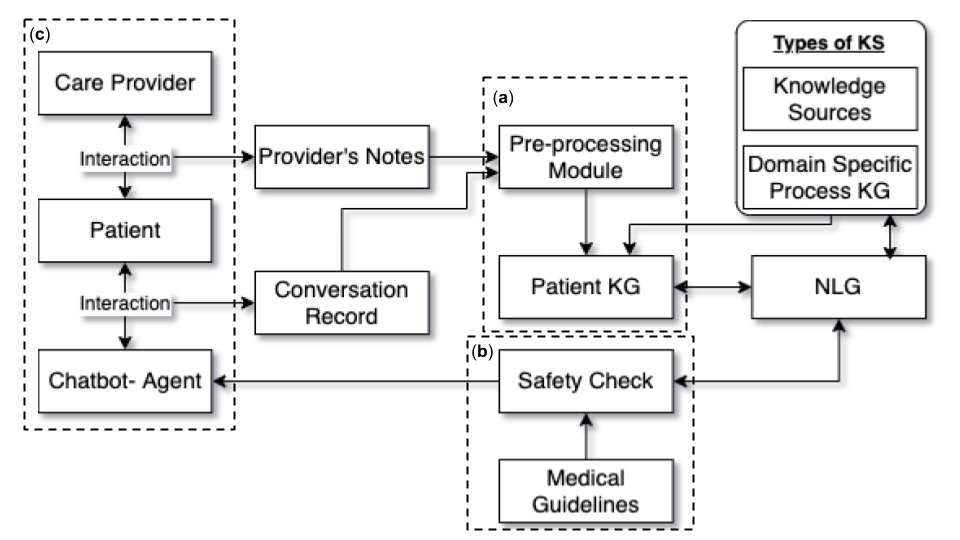
Figure 1: (a) Alleviate constructs a consolidated knowledge base by drawing from knowledge databases that are mental health domain specific – Eg: Suicide and Depression Rating scales, broader medical context based – Eg: Medication interactions and side-effects. Alleviate integrates the extracted knowledge with patient-specific information to form a personalized patient knowledge graph. (b) Alleviate’s task executions conform strictly to clinically established safety standards and medical guidelines provided to Alleviate’s AI backend in the form of knowledge graph path constraints. (c) Alleviate’s algorithms support constant feedback-based refinements through continued patient and care-provider interactions in a reinforcement learning setup
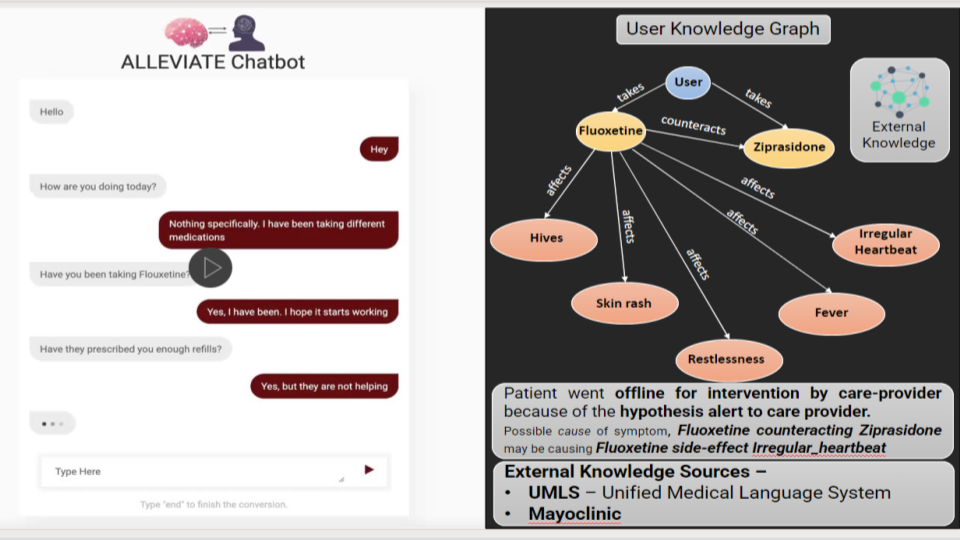
Figure 2: Alleviate integrates the user’s personal medication information and the information contained in medical knowledge databases such as the mayo clinic and the Unified Medical Language System (UMLS) to perform medication inquiries and troubleshooting.
Patient Appraisal on Adherence to Medical Recommendations
Alleviate’s patient knowledge graph is utilized to perform inquiries about adherence to medical recommendations obtained from the provider notes written by the care provider during offline patient-provider interactions. Figure 3 shows Alleviate praising a user for completing the recommended amount of weekly exercise.
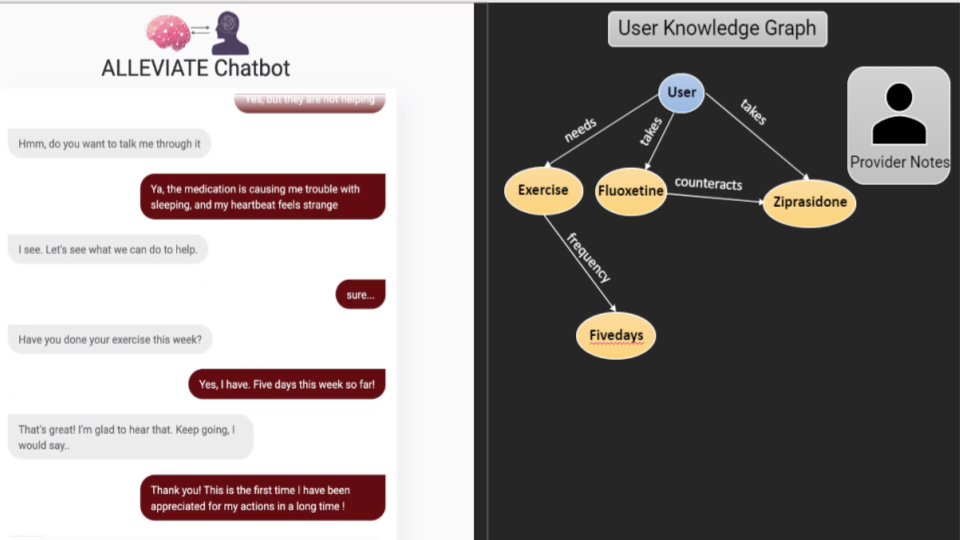
Figure 3: Alleviate praises the user for adherence to medical recommendations contained in the provider notes written by the care provider. Here, Alleviate appreciates the user accomplishing five days of exercise that week.
Behavior Detection Requiring Emergency Human Intervention
Alleviate continuously performs safety checks to detect conversation patterns that require emergency human intervention. Alleviate computes dense representation similarities matching with concepts from clinically established alarming behavior detection questionnaires represented as trees to determine the time for emergency intervention.
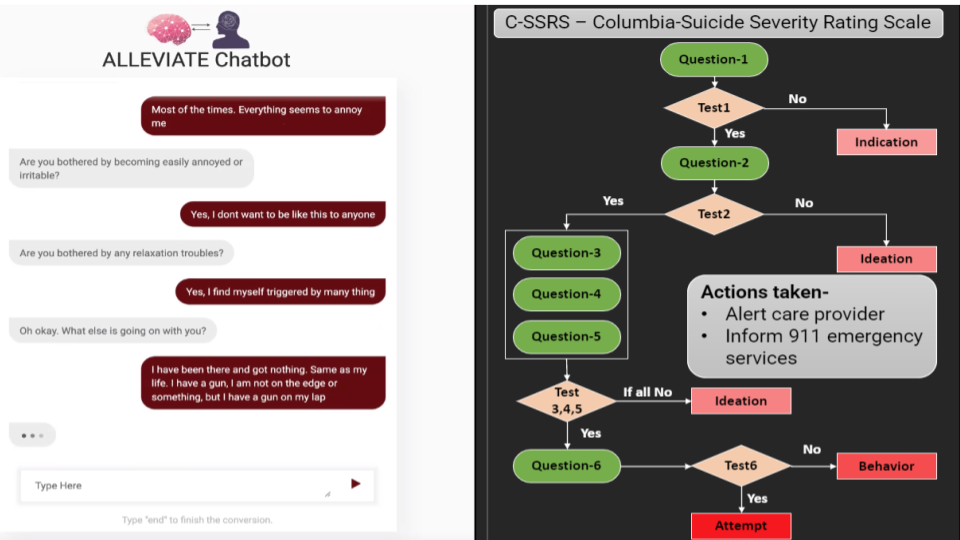
Figure 4: Alleviate constantly monitors patient conversation for patterns requiring emergency human intervention. Here, Alleviate alerts emergency services of the patient’s potential suicidal ideation.
Conclusion
In this work, we propose Alleviate, a mental health chatbot designed to assist care providers with safe and explainable personalized patient care. Alleviate’s integrated use of personal information, medical knowledge, and mental-health questionnaires encoded as graphs and trees allow easy modeling of safety conformance using graph and tree path constraints. The structure of the graphs and trees enables explanation of Alleviate’s functions.
References
Cameron, D.; Kavuluru, R.; Rindflesch, T. C.; Sheth, A. P.; Thirunarayan, K.; and Bodenreider, O. 2015. Context-driven automatic subgraph creation for literature-based discovery. Journal of biomedical informatics, 54: 141–157.
Gupta, S.; Agarwal, A.; Gaur, M.; Roy, K.; Narayanan, V.; Kumaraguru, P.; and Sheth, A. 2022. Learning to Automate Follow-up Question Generation using Process Knowledge for Depression Triage on Reddit Posts. In Proceedings of the Eighth Workshop on Computational Linguistics and Clinical Psychology, 137–147. Seattle, USA: Association for Computational Linguistics.
Jaimini, U.; Thirunarayan, K.; Kalra, M.; Venkataraman, R.; Kadariya, D.; Sheth, A.; et al. 2018. “How Is My Child’s Asthma?” digital phenotype and actionable insights for pediatric asthma. JMIR pediatrics and parenting, 1(2): e11988.
Rawte, V.; Chakraborty, M.; Roy, K.; Gaur, M.; Faldu, K.; Kikani, P.; Akbari, H.; and Sheth, A. P. 2022. TDLR: Top Semantic-Down Syntactic Language Representation. In NeurIPS ’22 Workshop on All Things Attention: Bridging Different Perspectives on Attention.
Roy, K.; Gaur, M.; Rawte, V.; Kalyan, A.; and Sheth, A. 2022a. ProKnow: Process Knowledge for Safety Constrained and Explainable Question Generation for Mental Health Diagnostic Assistance. arXiv preprint arXiv:2204.12560.
Roy, K.; Gaur, M.; Zhang, Q.; and Sheth, A. 2022b. Process Knowledge-infused Learning for Suicidality Assessment on Social Media. arXiv preprint arXiv:2204.12560.
Roy, K.; Lokala, U.; Khandelwal, V.; and Sheth, A. 2021a. ” Is depression related to cannabis?”: A knowledge-infused model for Entity and Relation Extraction with Limited Supervision. Proceedings of the AAAI 2021 Spring Symposium on Combining Machine Learning and Knowledge Engineering (AAAI-MAKE 2021), 2846.
Roy, K.; Zhang, Q.; Gaur, M.; and Sheth, A. 2021b. Knowledge infused policy gradients for adaptive pandemic control. In CEUR Workshop Proc.
Roy, K.; Zhang, Q.; Gaur, M.; and Sheth, A. 2021c. Knowledge infused policy gradients with upper confidence bound for relational bandits. In Joint European Conference on Machine Learning and Knowledge Discovery in Databases, 35– 50. Springer.
Sheth, A.; Gaur, M.; Roy, K.; Venkataraman, R.; and Khandelwal, V. 2022. Process Knowledge-Infused AI: Toward User-Level Explainability, Interpretability, and Safety. IEEE Internet Computing, 26(5): 76–84.
WCVB. 2020. 40% of US adults reported struggling with mental health or substance abuse, according to June CDC survey. http://bit.ly/news mental health. Accessed: 2022- 12-10.
WHO. 2022. Covid-19 pandemic triggers 25% increase in prevalence of anxiety and depression worldwide. https://www.who.int/news/item/02-03-2022-covid-19-pandemic-triggers-25-increase-in-prevalence-of-anxietyand-depression-worldwide. (Accessed on 11/01/2022).