


Abstract
Personalizing conversational agents can enhance the quality of conversations and increase user engagement. However, they often lack external knowledge to appropriately tend to a user’s persona. This is crucial for practical applications like mental health support, nutrition planning, culturally sensitive conversations, or reducing toxic behavior in conversational agents. To enhance the relevance and comprehensiveness of personalized responses, we propose using a two-step approach that involves (1) selectively integrating user personas and (2) contextualizing the response by supplementing information from a background knowledge source. We develop K-PERM (Knowledge-guided PErsonalization with Reward Modulation), a dynamic conversational agent that combines these elements. K-PERM achieves state-ofthe-art performance on the popular FoCus dataset, containing real-world personalized conversations concerning global landmarks. We show that using responses from K-PERM can improve performance in state-of-the-art LLMs (GPT 3.5) by 10.5%, highlighting the impact of K-PERM for personalizing chatbots. Our code is released to the public for further explorations: https://github.com/kanak8278/DialogKPERM
Introduction
Recent trends in Large Language Models (LLMs) have demonstrated remarkable abilities in conversational AI (Jo et al. 2023)(Shin, Hsieh, and Kim 2023). However, personalization is a potential area for LLMs that requires improvement (Zhang et al. 2023). Personalization in conversational AI can go beyond chit-chat conversations and aid in user engagement by understanding their personas better and providing accurate responses (Bender et al. 2021)(Joshi, Mi, and Faltings 2017).
Prior research on personalization has primarily focused on casual conversations, emphasizing details such as a user’s preferences. The lack of external knowledge hinders a model’s ability to adapt to different personas (Deshpande et al. 2023). Therefore, recent shifts in chatbot personalization utilize both persona information and knowledge (Qian et al. 2021) (Liu et al. 2023). However, identifying a suitable context aligned with user preferences during a conversation remains a significant challenge for current LLMs.
While using various prompting methods may allow a user to steer LLMs toward desired behavior, they only work at an utterance level. This may not be feasible for longer conversations, as the context often shifts (Shuster et al. 2021). Therefore, we require the chatbot to learn how to retrieve appropriate content based on a user’s query and assess whether a response requires contextualization (retrieval of meta-information) and personalization (selecting appropriate persona, if necessary).
To address this issue, we propose using Knowledgeguided PErsonalization of response generation with Reward Modulation (K-PERM). K-PERM uses dynamic knowledge retrieval along with personalization to improve a machine’s adaptive capabilities to different personas and contexts. Our Personalized Response Generation task involves two major components:
- Understanding Conversation Context: We use Dense Passage Retrieval (DPR) (Karpukhin et al. 2020) to select the most pertinent information from a larger text corpus containing real-world information.
- Incorporating Appropriate Personas: We introduce a selector module capable of choosing a persona that aligns with the user query. We model persona selection as a multiple-choice question-answering task, which includes an option to opt for “no-persona” in generic cases.
To the best of our knowledge, our study is the first to dynamically and flexibly incorporate knowledge, persona, and conversation history into a learning strategy that can be used to train or guide LLMs to be personalized. Our modelagnostic framework can be utilized to train conversational agents for personalized response generation in open-domain settings. K-PERM outperforms prior attempts in personalization despite being a 24 times smaller model. We also augment GPT 3.5 with K-PERM’s responses and show a considerable improvement of 10.5% when compared to GPT3.5 in a zero-shot setting. Our results demonstrate that knowledgeguided learning can help guide conversational agents toward better personalization.
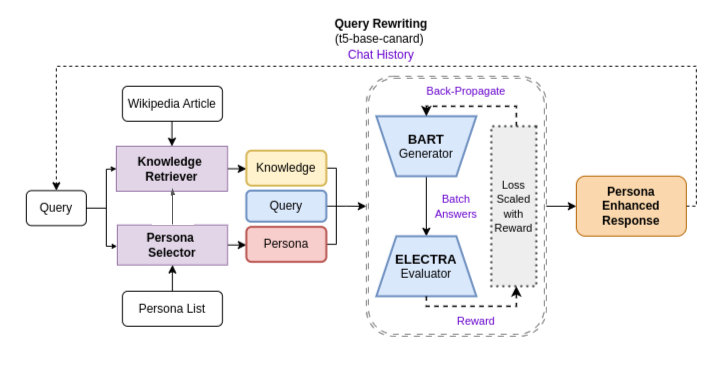
Figure 1: K-PERM Model Architecture Overview. The model architecture comprises a Persona Selector and Knowledge Extractor, which leverages the history and question prompt to identify pertinent persona and knowledge.
Methodology
Experiments
We utilize the FoCus dataset developed by Jang et al. (2022) for our experiments, as it contains customized answers built with persona and Wikipedia knowledge instead of just persona ((Zhang et al. 2018)). See Appendix A for dataset details. Our experiments use BART as the language model (Pθ). Fine-tuning details are described in Appendix C.
Evaluation Criteria
We used Rouge–1/2/L/L-Sum and BLEU scores to evaluate K-PERM. In addition, we use two transformer-based metrics for evaluating natural language generation: BERTScore (BF1: BERTScore F1-score) and NUBIA, which measure semantic relations, contractions, irrelevancy, and logical agreement (Zhang et al. 2020; Kane et al. 2020). Semantic relations evaluate whether the generated text is relevant and coherent and maintains the intended meaning and context of the input query. Measuring these characteristics for our proposed model is important to ensure LLMs’ correct merging of knowledge and persona.
Baselines
We compare our model with two baselines – (1) GODEL: A large pre-trained Transformer-based encoder-decoder model for goal-directed dialogues similar to FoCus (Peng et al. 2022). We used the pre-trained GODEL model and enhanced it with personalization by incorporating a persona selected by our persona selector model; (2) BARTFoCus: We utilized the BART model provided with the FoCus dataset (Jang et al. 2022). We fine-tuned this model (BARTFoCus) using our training and validation sets for a fair comparison. Results are reported on our test set, although it was not made available by the authors of the FoCus dataset.
Results and Discussion
Table 1 compares three models: BARTFoCus (406 Million Parameters), GODEL (6 Billion parameters), and K-PERM (250 Million parameters). The results show that the pre-trained version of GODEL, without personalization, performed worse than BARTFoCus. However, when GODEL incorporated our persona selector model, it achieved a syntactic similarity closer to BARTFoCus, suggesting that the persona-based approach improved GODEL’s syntactic quality—in terms of semantic similarity measured by BERTScore, GODEL with persona outperformed BARTFoCus, indicating that GODEL, when utilizing personas, generated responses that were more semantically similar to the desired outputs. K-PERM significantly outperformed GODEL in terms of syntactic generation quality and semantic similarity. Ablation studies (see Appendix Table 2) on K-PERM showed that using the ground persona and our persona selector resulted in the highest quality generation both syntactically and semantically. However, there were cases where K-PERM ignored the persona for specific queries requiring personalization, resulting in errors compared to using the ground persona. Despite this limitation, the knowledge retriever used in K-PERM demonstrated competitive performance, relying on information from Wikipedia articles rather than handcrafted knowledge in the FoCus dataset.
Another set of experiments with K-PERM using NUBIA as the metric (see Table 2) showed that using personas yielded better semantic relations, logical agreement, lower contradiction, and lower irrelevancy compared to providing all personas simultaneously. When using retrieved knowledge, K-PERM achieved a higher NUBIA score compared to using handcrafted knowledge in BARTFoCus. In a blind assessment of responses obtained from 5 different systems, generated across 90 user queries with varying numbers of personas, K-PERM consistently outperformed the competition. It achieved the top position in 54 query cases, showcasing its remarkable performance in contrast to GODEL and GPT 3.5, as depicted in Appendix Figure 3.
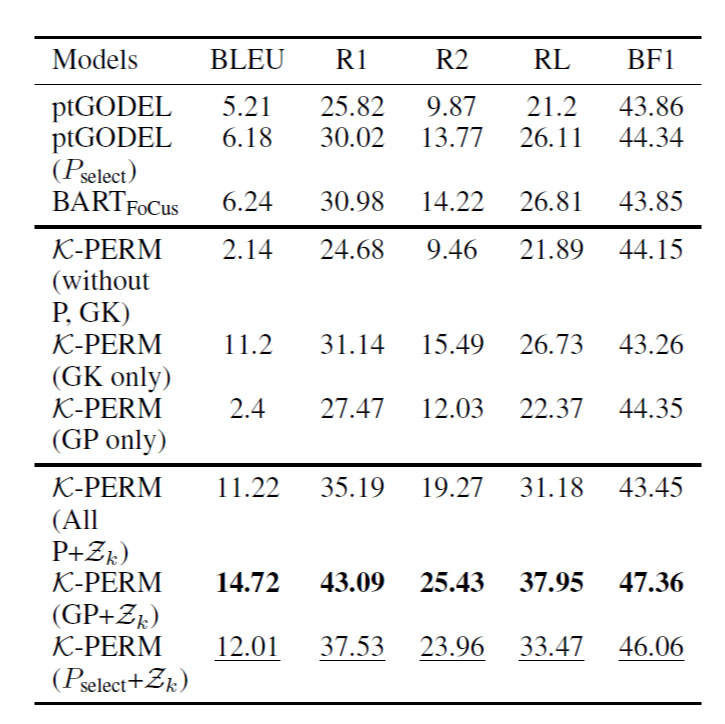
Table 1: Performance of K-PERM on FoCUS dataset. SP:Pselect, GP: Ground Persona, Zk: Retrieved Knowledge, P: Persona, GK: Ground Truth Knowledge. Bold-face: Best and Underlined is 2nd best. pt: pre-trained.
Finally, we use K-PERM to augment a state-of-the-art LLM, GPT3.5. Our results in Figure 2 show that augmenting GPT3.5 with K-PERM improves its performance significantly (10.5%), highlighting the advantage of K-PERM in personalization.
Conclusion
We created K-PERM, a practical and comprehensive technique for generating personalized responses, demonstrating its superior performance compared to baseline methods. Notably, K-PERM responses closely match human-curated responses on the FoCus dataset. Despite being a simpler language model than ChatGPT, K-PERM ranked second in aligning generated responses with the ground truth in FoCus. The reward modulation setting in K-PERM successfully achieves the desired response generation, enabling it to guide large language models like GPT 3.5 to produce personalized results. Our approach can extend to other domains and large language models using relevant goal-oriented and personalized datasets.
Limitations
- We evaluate K-PERM only on the FoCus dataset. To the best of our knowledge, only one dataset incorporates persona, context, and queries together. However, we believe that with the growing interests and advancements, more such datasets will be constructed, and the solutions will evolve and be generalized.
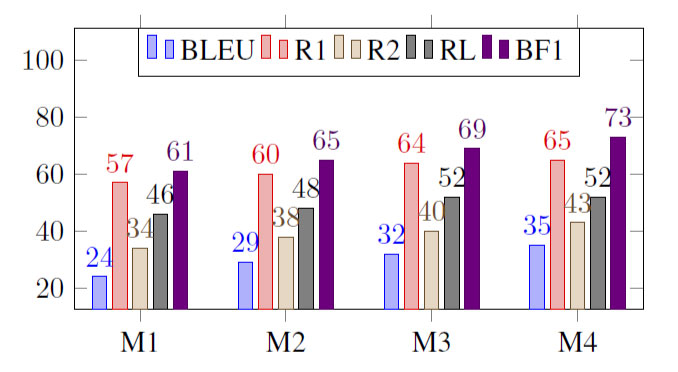
Figure 2: K-PERM improves personalization in GPT 3.5 via zero-shot prompting. This experiment aimed to assess the performance improvement of GPT 3.5 when combined with K-PERM. M1 is GPT 3.5 and M2, M3, and M4 represents zero-shot prompting of GPT 3.5 using responses from KPERM with (All P+Zk), (GP+Zk), and (Pselect+Zk) respectively. Score were rounded off for visibility.
- Our methodology did not thoroughly experiment with all the state-of-the-art LLMs such as Llama and Mistral (Jiang et al. 2023). However, as our methods are modelagnostic, applying our work to these models should yield comparable results.
Appendix
A Dataset
We utilize the publicly available FoCus dataset, which consists of passages describing landmarks (Jang et al. 2022). The dataset includes 13,484 dialogs for training and validation, with an average of 5.6 rounds per dialog and approximately 7,715 Wikipedia landmarks. The dialogs contain a total of 75,971 utterances, with an average length of 24.0 per utterance. We split the dataset into three sets: train (10,284 samples), validation (1,600 samples), and test (1,600 samples), comprising 57,928, 9,008, and 9,035 utterances, respectively. The training set includes 36,472 knowledge-based utterances and 21,456 utterances with both persona and knowledge, coming from 4,918 landmarks. Validation and test datasets consist of 5,664 and 5,707 knowledge-based utterances, respectively. Additionally, the validation set includes 3,344 utterances featuring both persona and knowledge, while the test set comprises 3,328 such utterances. The validation set encompasses 1,414 Wikipedia landmarks, whereas the test set involves 1,383 landmarks. The dataset references “ground persona” and “ground knowledge,” representing the ground truth persona and passage selected by crowd workers. Additionally, all the questions in the dataset were rewritten using T5-CANARD, a query-rewriting model (Qian and Oard 2021) (Table 4 shows why question rewriting was needed).
B Related Work
PersonaChat and PersonaChat 2.0 are chit-chat conversation datasets used to train conversational agents (Liu, Peng, and Ni 2022; Wu et al. 2020). They incorporate encoder-decoder
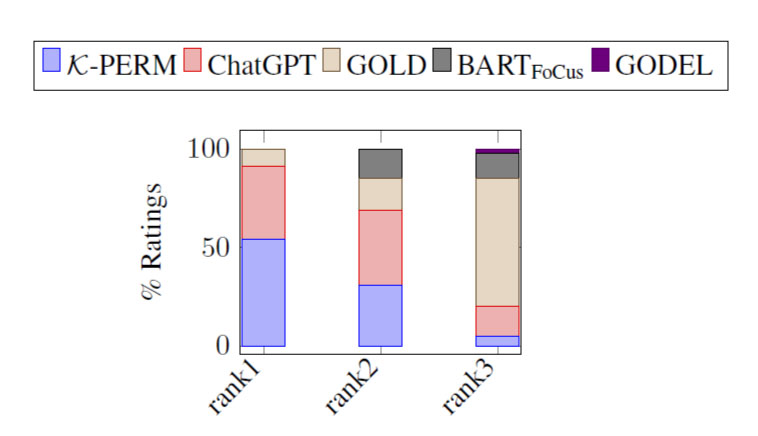
Figure 3: K-PERM was preferred 32% more than ChatGPT by the annotators based on a blind evaluation of 90 queries taken randomly from the FoCus dataset. GOLD is the ground truth in FoCus Dataset.
models, reinforcement learning, few-shot learning, and hierarchical attention mechanisms to improve personalization by considering persona and conversational history (Li et al. 2016; Qiu and Zhang 2021; Young et al. 2022). In previous personalization work, external knowledge was not a significant focus until Mazumder et al. introduced retrieval as a sub-task in PersonaChat to enhance personalization (Majumder et al. 2021). However, their method was not specifically evaluated on retrieval performance, using ROC Stories as a proxy knowledge source. This approach did not adequately capture personalization, especially for goal-oriented or information-seeking dialogues. K-PERM addresses this gap by introducing retrieval augmented generation as a practical baseline to improve personalization (Gaur et al. 2022; Lewis et al. 2020). Unlike previous approaches that finetuned models on PersonaChat, K-PERM uses base generative models for evaluation and achieves desired behaviors through reinforcement learning as the evaluator (Lipton et al. 2018; Huang et al. 2023). Additionally, K-PERM introduces unique persona selection, making it the first realistic response generation model for real-time goal-oriented or information-seeking dialogues.
C Human Evaluation
We conducted a blind evaluation of 90 responses generated from 5 systems. As the task was trivial, the authors instructed the annotators verbally. The task was made available on a participant pool management system which credits students completing the task. We experimented with five systems: K-PERM, BARTFoCus, ChatGPT, GODEL, and Ground Truth. Our model, K-PERM, consistently stood out as a top performer by securing first place in 11 instances and maintaining a strong second position in 68 instances. This underscores its exceptional performance. The Top 3 results and percentage of times any specific model is selected are depicted in Figure 3. Table 3 shows a sample from our human evaluation. More examples are present https://shorturl.at/uP023.
D Fine-Tuning MPNet for DPR
We used contrastive fine-tuning as described in (Song et al. 2020). Next, we employed a combination of localitysensitive hashing (LSH) and Facebook AI Semantic Search (FAISS), which uses Maximum Inner Product Search (MIPS) (Johnson, Douze, and Jegou 2019) to efficiently obtain Z Ut K . We evaluated the knowledge retriever’s efficiency using BERTScore, which is commonly used to compare retriever-augmented generations(Lim et al. 2023).
We varied K between 5 and 20 and observed high similarity (BERTScore) with ground truth passages (from the FoCus dataset) at K = 10. Therefore, we agreed that the appropriate number of retrieved passages would be 10. We also experimented with different Sentence Transformer models for dense encodings other than MPNet and standard retrievers such as TF-IDF and BM25 (refer to Appendix Table 4).
E Training Process
We employed BART, an auto-regressive encoder-decoder model, for generating personalized responses by incorporating special tags like <question>, <knowledge>, <history>, and <persona> during fine-tuning. Training took approximately 16 hours on a single NVIDIA T4 GPU, and response generation utilized beam search with a beam size of 5 for stability over nucleus sampling.(Chen and Yang 2021; Shaham and Levy 2022).
Acknowledgements
We acknowledge partial support from the UMBC Faculty Fellowship to Dr. Manas Gaur. We also acknowledge HighPerformance Computing Support from HealthcareNLP Softech LLC and NSF MRI Award #1920079. Any opinions, conclusions, or recommendations expressed in this material are those of the authors and do not necessarily reflect the views of the NSF, UMBC, or HealthcareNLP Softech LLC.
References
Bender, E. M.; Gebru, T.; McMillan-Major, A.; and Shmitchell, S. 2021. On the dangers of stochastic parrots: Can language models be too big? In Proceedings of the 2021 ACM conference on fairness, accountability, and transparency, 610–623.
Chen, J.; and Yang, D. 2021. Structure-aware abstractive conversation summarization via discourse and action graphs. arXiv preprint arXiv:2104.08400.
Clark, K.; Luong, M.-T.; Le, Q. V.; and Manning, C. D. 2019. ELECTRA: Pre-training Text Encoders as Discriminators Rather Than Generators. In International Conference on Learning Representations.
Clark, K.; Luong, M.-T.; Le, Q. V.; and Manning, C. D. 2020. Electra: Pre-training text encoders as discriminators rather than generators. arXiv preprint arXiv:2003.10555.
Deshpande, A.; Murahari, V.; Rajpurohit, T.; Kalyan, A.; and Narasimhan, K. 2023. Toxicity in chatgpt: Analyzing persona-assigned language models. arXiv preprint arXiv:2304.05335.
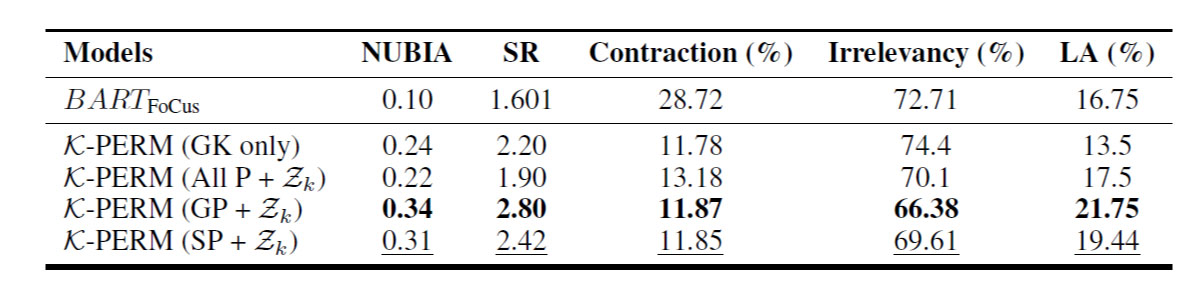
Table 2: Performance of K-PERM using NUBIA Score. Results are compared with baseline BARTFoCus. Bold-faced are best (GP), and Underlined are second-best (Pselect). LA: Logical Agreement, SR: Semantic Relatedness.
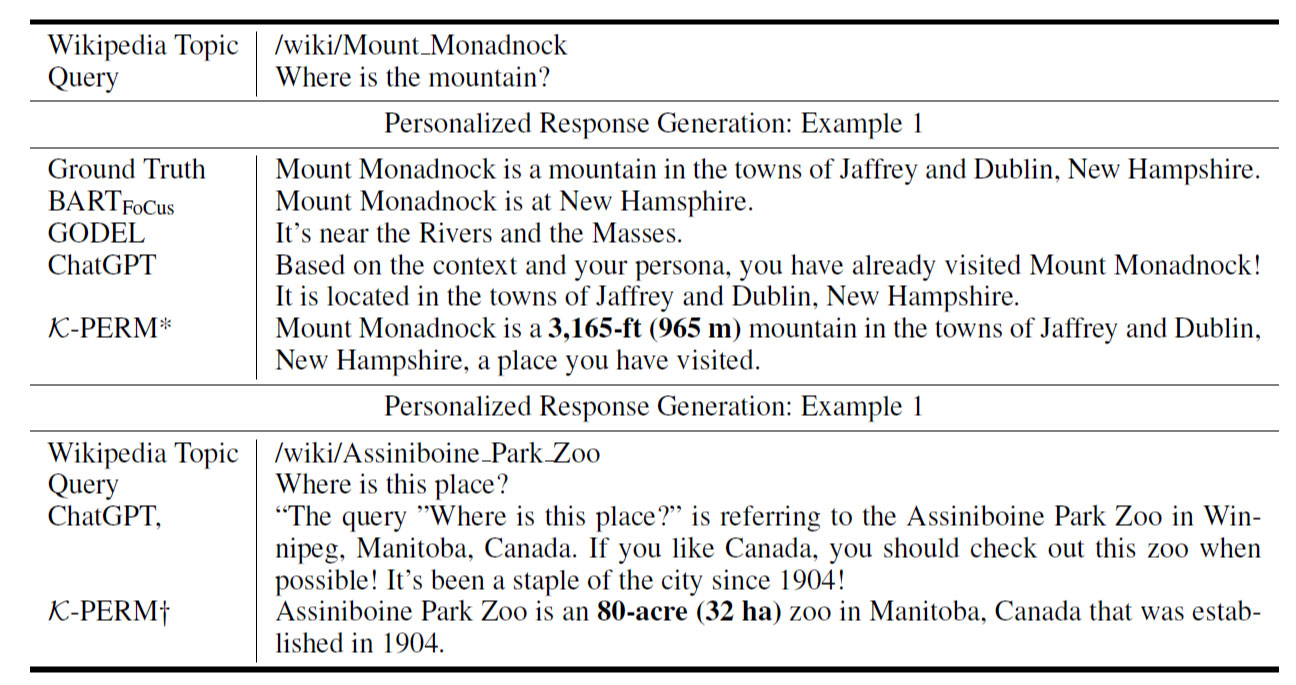
Table 3: Human Assessment: K-PERM did better than ChatGPT in terms of personalized response generation. The personas “I have been to New Hampshire” (top) and “I like visiting Canada” (bottom) were used in the examples above. We boldface numeric values to show focus on the correctness of information delivery using a retrieval-augmented generation mechanism.
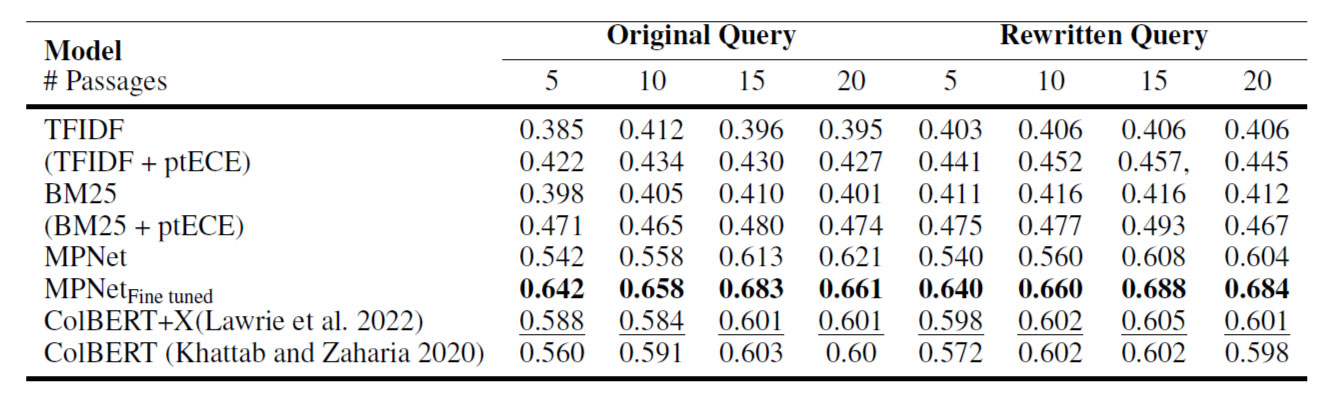
Table 4: Evaluating knowledge retrievers over the indexed landmark Wikipedia articles in the FoCus dataset. Each score represents the maximum BERTScore computed between the retrieved passages and ground truth knowledge in FoCUS. ptECE: pre-trained ELECTRA Cross Encoder (Clark et al. 2020). Bold: Best, Underlined: 2nd best.