We’ve raised Series A from M12 (Microsoft Venture Fund). Read More
AI for risk adjustment

Home » Blogs 

AI for Risk Adjustment: Choosing Whether to Build or Buy

Introduction

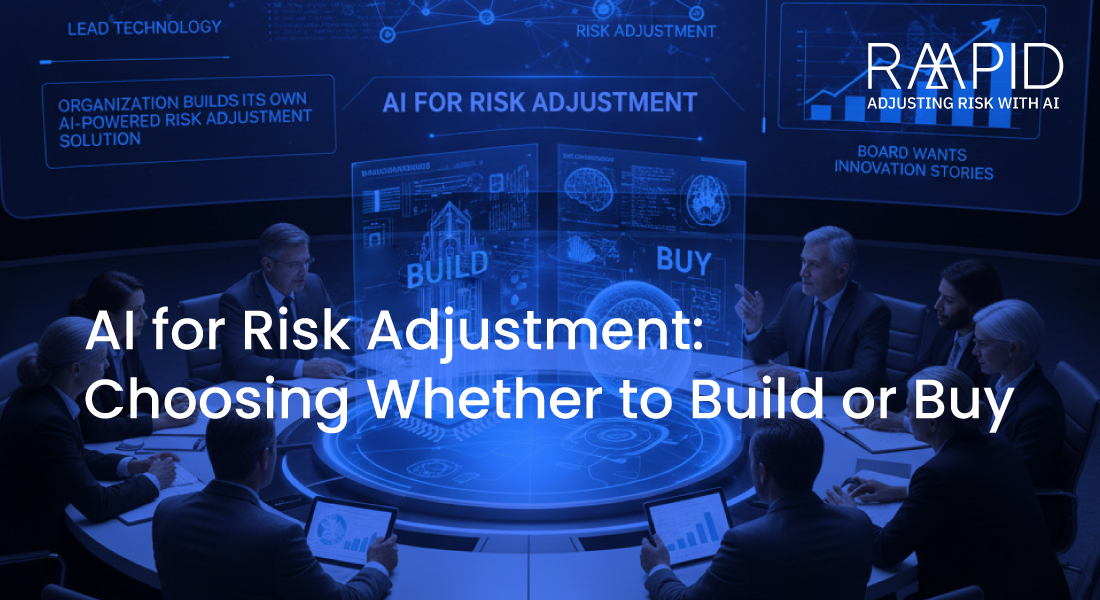
If you lead technology or risk adjustment at a Medicare Advantage plan, you’ve faced this question: Should an organization build its own AI-powered risk adjustment solution?

Your data science team is eager. Your board wants innovation stories. And building in-house feels like the path to competitive differentiation.

What This Blog Covers

This blog examines what building in-house solutions truly demands, what a strategic collaboration delivers, and provides an honest comparison of both paths. We’ll also explore how to build cross-functional support across your leadership team and offer a decision framework to help you choose the right path for your organization.

Gartner predicts that through 2026, organizations will abandon 60% of automation projects that aren’t supported by data-ready infrastructure [1].

Data readiness is a challenge for any technology initiative, whether you build or partner. The difference is how quickly you can close the gap. An in-house build requires your team to solve the data-readiness problem from scratch while simultaneously developing the solution. An explainable AI vendor has already solved it, with models trained and validated across millions of clinical charts.

Before you commit years of effort and significant budget, let’s examine what the build path actually requires and why a strategic partnership may be the more intelligent choice for most sophisticated players.

What Does Building In-House AI for Risk Adjustment Actually Demand?

Building enterprise-grade AI technology for risk adjustment isn’t a data science side project. It’s a multi-year infrastructure commitment that consumes your best technical talent. Think about the cross-functional expertise required:

  • Data Scientists
  • ML Engineers
  • Clinical Informaticists
  • Compliance Specialists

Bringing this range of specialists together and keeping them coordinated over the long term is a substantial organizational lift. On top of that, the work demands a sophisticated infrastructure backbone, including MLOps pipelines, continuous retraining cycles, and HITRUST-certified data lakes to support secure, compliant model operations. Even with all of this in place, recruiting PhD-level researchers who can navigate the clinical, regulatory, and data intricacies of healthcare coding remains a recruiting challenge in itself.

According to McKinsey’s 2025 research, 47% of C-suite leaders say their organizations are developing automation tools too slowly. Another 46% cite talent skill gaps as the primary reason [2]. The talent bottleneck isn’t unique to your organization. It’s an industry-wide constraint. Even with the right team, most healthcare organizations lack the technical foundation.

A January 2025 HIMSS Market Insights study found that only 18% of healthcare organizations say they’re ready to deploy clinical intelligence in care delivery [3].

For an internal build, this means significant investment in data architecture, cloud infrastructure, and security frameworks, all before your team writes a single line of model code.

“54% are concerned that they do not currently have the right internal clinical capabilities to deliver, deploy, and scale AI systems.” (IBM Institute for Business Value, Healthcare in the AI Era Report, 2025)

And after all that effort, internal builds typically plateau at accuracy levels that leave unsupported HCCs exposed to compliance failures and clawback liability.

Autonomous Retrospective Risk Adjustment Solution

One platform. Every HCC validated. Revenue secured.

Retrospective Risk Adjustment Solution

What Does a Strategic Clinical AI Partnership Deliver?

An Explainable AI-driven collaboration offers a different model: speed without sacrificing quality, and scale without added burden.

Where an in-house build starts from scratch, an explainable AI vendor brings models already trained on millions of clinical charts. The nuances of medical documentation have already been learned, eliminating years of training your team would otherwise need to replicate.

It is critical to distinguish this “Clinical AI” from general-purpose “Gen AI.” While standard Gen AI models are designed for creativity and can be prone to “hallucinations” (inventing facts), Clinical AI is purpose-built for precision. It operates within strict regulatory guardrails, ensuring that every code is factually derived from the chart, not statistically guessed.

“Among those implementing gen AI, external collaborations are the dominant strategy for adoption, with 61% pursuing third-party vendors as their primary approach.” (McKinsey & Company, Generative AI in Healthcare: Current Trends and Future Outlook, March 2025)

The right vendor doesn’t just deliver HCC suggestions. It delivers explainable results, linking every code to MEAT-based clinical evidence. Look for solution providers that use neuro-symbolic AI architectures, which combine machine learning’s pattern recognition with rule-based clinical logic to deliver transparent, auditable results.

This transparency transforms the audit response from chaos to confidence.

How Neuro-Symbolic AI Actually Works

Diagram showing how neuro-symbolic AI for risk adjustment combines machine learning pattern recognition with rule-based clinical logic to deliver explainable HCC coding results.

External collaboration also provides operational flexibility. Scale processing up during peak periods such as the Annual Enrollment Period (AEP) and scale back during quieter months, without carrying idle infrastructure year-round. And when CMS requirements evolve, or ICD-10-CM codes are updated, the vendor bears the burden of continuous model updates.

For CIOs concerned about third-party data risk, the right arrangement offers deployment within your own environment. Data sovereignty stays intact. Security certifications, including HITRUST, HIPAA, and SOC 2, are already in place.

Build vs Buy AI for Risk Adjustment: An Honest Comparison

Both paths have genuine advantages and trade-offs.

“I think it’s in our best interest, for the long term, to partner with best-of-breed partners.” (Todd Schwarzinger, Partner, Cleveland Clinic Ventures, HLTH 2025 Conference)

Building In-House AI for Risk Adjustment

Potential Advantages:

  • Full control over the product roadmap
  • Long-term IP ownership
  • Deep customization
  • Internal capability building

Likely Challenges:

  • Extended timeline (years, not months)
  • Significant capital commitment with uncertain returns
  • Talent acquisition difficulties
  • Accuracy ceilings below Clinical AI solutions, along with an ongoing regulatory maintenance burden

Choosing an Explainable AI Vendor

Potential Advantages:

  • Faster time to value
  • Pre-validated accuracy
  • Lower execution risk
  • Regulatory updates handled by the solution provider
  • Operational scalability

Likely Challenges:

  • Less control over the roadmap
  • Vendor dependency
  • Integration complexity
  • Some customization limits

How to Build Cross-Functional Support for AI Investment

Technology decisions of this scale require buy-in beyond IT.

For the VP of Risk Adjustment: Clinical AI solutions replace audit chaos with structure, delivering explainable clinical intelligence that links every HCC to clinical evidence.

For the CFO: According to a 2025 Deloitte survey, only 21% of finance leaders believe their technology investments have delivered clear, measurable value [4]. Outsourcing offers defined costs and proven ROI, not open-ended R&D spend.

For the COO: The AMA’s 2025 report found that 43.2% of physicians experience burnout symptoms, costing the healthcare system billions annually [5]. Your coding teams face similar pressures. A proven vendor reduces manual review time, freeing your team to focus on higher-value work.

For the CIO: Working with an Azure-native solution means deploying within your own tenant, keeping data within your environment, and having certifications already in place.

When you bring this decision to the leadership table, you’re presenting a solution that addresses concerns across the C-suite in a single decision.

The Decision Framework: Build vs Buy AI for Risk Adjustment

How do you decide which path is right for your organization?

“Healthcare is at a turning point. Organizations that embrace data-driven decision-making, automation, and workforce engagement strategies will be best positioned to thrive.” (Deloitte, 2025 Global Health System Survey)

Consider Building If All of These Apply:

  • You have a multi-year runway before you need results
  • You can commit significant capital without guaranteed returns
  • You have or can recruit PhD-level technology talent
  • Risk adjustment automation is a core long-term differentiator
  • Your data infrastructure and clinical informatics teams are already mature

Consider a Partnership If All of These Apply:

  • You need operational results within the next year
  • Your coding teams are already stretched thin
  • Audit readiness is an immediate priority
  • Budget predictability matters more than IP ownership
  • You want proven accuracy without absorbing ongoing regulatory maintenance

When evaluating vendors, prioritize solutions with explainable technology architectures that can trace every HCC suggestion back to specific MEAT criteria in the clinical documentation. Look for data-provenance capabilities that let you click a code and see the exact highlight in the medical record. This level of traceability is what separates audit-ready Clinical AI platforms from generic opaque tools.

For most organizations facing near-term pressure, buying isn’t a compromise. It’s the strategically superior choice:

Faster results
Higher accuracy
Lower cost
Reduced execution risk

Conclusion

This isn’t a build-versus-buy decision. It’s a speed-versus-delay decision.

Every month spent building is a month your competitors are capturing accurate risk scores and defending audits with confidence. Building in-house isn’t wrong. It fits specific circumstances. But for most MA plans facing near-term deadlines and audit pressure, the right vendor delivers faster deployment, higher accuracy, and aligned outcomes across your leadership team.

Your CIO gets enterprise-grade security. Your CFO gets predictable ROI. Your COO gets operational efficiency. Your VP of Risk Adjustment gets audit-ready defensibility.

One decision. Aligned outcomes. It’s the approach RAAPID was built to deliver, with explainable technology that traces every HCC to clinical evidence.

Ready to Evaluate a Collaborative Path?

Over a Partnership Evaluation Call.

Industry First Autonomous RADV Audit Solution 1

Frequently Asked Questions

Building in-house typically requires 2-4 years before achieving production-ready accuracy. A Clinical AI partner can deploy within months, with models already trained and validated across millions of clinical charts.

Building requires significant upfront capital for talent, infrastructure, and ongoing maintenance, often with uncertain ROI. Partnership offers predictable costs, defined implementation fees, and measurable returns without open-ended R&D investment.

Yes. Clinical AI partners design for interoperability. The right solution integrates with major EHR platforms, claims systems, and data warehouses, deploying within your existing Azure environment to maintain data sovereignty.

The model itself is built once, but every October 1st clinical modification freeze and every quarterly CMS recalibration forces major adjustments. That continuous tuning, and not the initial build, is what makes in-house modeling so difficult to sustain.

A Clinical AI partner absorbs the burden of continuous regulatory monitoring. When CMS updates HCC models (V24 to V28) or ICD-10-CM codes change, the partner updates the AI framework. This eliminates maintenance work for your internal team.

Most teams underestimate the ongoing work.

Internal builds typically plateau in the 60-75% accuracy range. In contrast, specialized Clinical AI partners deliver 92-98% coding accuracy because their models are pre-trained on millions of clinical documents and continuously refined.

The right partner deploys within your own cloud tenant. Your data never leaves your environment. Look for HITRUST, HIPAA, and SOC 2 certifications as baseline security requirements.

Building may fit if you have a multi-year runway, can commit significant capital without guaranteed returns, can recruit PhD-level AI talent, and view risk adjustment AI as a core long-term differentiator.

Explainable AI links every HCC suggestion directly to MEAT-based clinical evidence in the source documentation. The most advanced solutions combine machine learning pattern recognition with rule-based clinical logic to create transparent reasoning paths. This architecture creates an audit-ready trail, unlike opaque models that provide code without clear justification.

Most organizations see measurable ROI within the first year of deployment. Defined implementation costs, productivity gains of 60-80%, and over 98% accuracy deliver faster financial returns than multi-year internal builds.

Lastest Posts

Subscribe To Our Newsletter

This field is for validation purposes and should be left unchanged.

Disclaimer: All the information, views, and opinions expressed in this blog are inspired by Healthcare IT industry trends, guidelines, and their respective web sources and are aligned with the technology innovation, products, and solutions that RAAPID offers to the Risk adjustment market space in the US.